

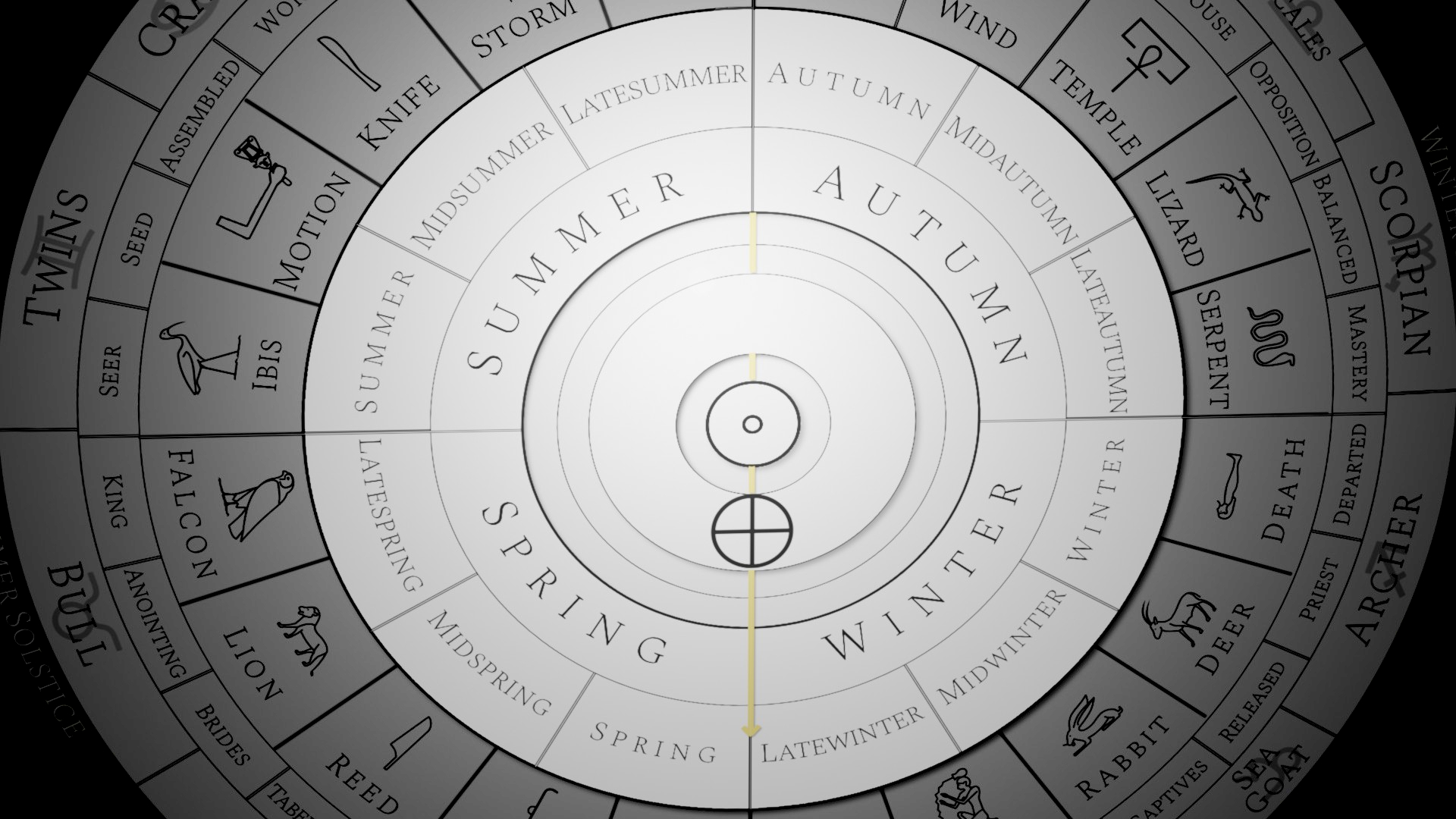

Structure
The Restored Enoch Calendar is constructed via principles gleaned from the Ethiopic text of 1 Enoch, which Dr. John P. Pratt discovered to include the following:
- The year is divided equally into four quarters named for the seasons (e.g., “Spring,” “Summer,” etc.) whose first day is always a Sunday;*
- Each quarter is divided into three months named for the stage of the season (e.g., “Summer,” “Midsummer,” “Latesummer”);
- Each month consists of exactly 30 days, each day beginning at sunset (not midnight);
- Between each of the four seasons is added one extra day, marking the holy solar transitions days (e.g., the vernal equinox, winter solstice, etc.);
- This makes for a year of 364 days (leap years have an extra week added and occur based on the nearness of a new moon to the new year); and
- The first day of a new year is then “1 Spring” (equating roughly to the end of March in our current calendars).
- Sacred dates within the calendar are based on those enumerated by Moses in the Torah along with the solar transitions days.
* The days of the week are in the same order and timing as we know them today in the Gregorian calendar (more on that in Solomon’s Priestly Courses).
Prophetic Time Keeping
In the course of attempting to reconstruct Enoch’s calendar, it was discovered that when overlaid upon known historical dates, events in Biblical history were found to match up in remarkable ways. In particular, the most sacred events in the life of Christ aligned with perfect symbolism to holy days on the Restored Enoch Calendar, as if to say that Enoch had foreseen the life of the Messiah prophetically and the calendar the angel gave him predicted his holy life.
Inasmuch as the Restored Enoch Calendar uses Hebrew calendar holy dates, it should not be wondered that the significance of the holy days themselves prefigure sacred events in history; what is remarkable is that in many places the Restored Enoch Calendar exceeds the Hebrew calendar in aligning these dates to sacred events.
Examples include:

| Event | Gregorian | Restored Enoch | Restored Enoch Holy Day | Hebrew Calendar | Hebrew Holy Day |
|---|---|---|---|---|---|
| Time Appointed to Man | 23 Mar 4055 BC | 1 Spring 0 | New Year | 1 Iyar -294 | – |
| Mortality Begins | 9 Apr 4001 BC (after sunset) | 15 Spring 55 | Firstborn (Easter/Adam Leaves Eden) | 14 Iyar -240 | – |
| Christ Baptized | 6 Oct 29 | 14 Autumn 4084 | Tabernacles | 12 Tishrei 3790 | – |
| Christ Begins Ministry | 6 Apr 30 | 14 Spring 4085 | Passover | 17 Nisan 3790 | – |
| Christ Transfigured | 2 Oct 32 | 14 Autumn 4087 | Tabernacles | 10 Tishrei 3793 | – |
| Christ Ministers to Spirit Prison | 2 Apr 33 | 14 Spring 4088 | Passover | 15 Nisan 3793 | Passover |
| Christ Resurrected | 3 Apr 33 | 15 Spring 4088 | Firstborn (Easter/Adam Leaves Eden) | 16 Nisan 3793 | – |
| Joseph Smith’s First Vision | 26 Mar 1820 | 1 Spring 5875 | New Year | 11 Nisan 5580 | – |
The Book of Enoch
As described above, the text of 1 Enoch describes the pattern for this time tracking system albeit in snippets that are somewhat difficult to understand. Here are some relevant selections to demonstrate the principles derived by Dr. Pratt:
“Uriel, the holy angel who was with me, explained to me; he who conducted them. The whole account of them, according to every year of the world for ever, until a new work shall be effected, which will be eternal….
“Their stations I wrote down as he showed them to me…. The moon brings on all the years exactly,* that their stations may come neither too forwards nor too backwards a single day; but that the years may be changed with correct precision in 364 days.** In three years the days are 1,092;… to the moon alone belong in three years 1,062 days…so that the moon has thirty days less than the sun and stars…. The year then becomes truly complete according to the station of the moon, and the station of the sun;… which rise and set in them for thirty days.…†
“…The four days which are added and never separated from the place allotted them, according to the complete calculation of the year. And these serve four days, which are not calculated in the calculation of the year”†† (1 Enoch 71:1; 73:2, 13-14, 12, 16; 74:1 – 2 [Richard Laurence translation, 1883]).
* I.e., the intercalation of leap years should be based on a pattern based on the appearance of new moons near the new year.
** The year has 364 days total.
† Each month has 30 days.
†† I.e., the four days are not part of the normal monthly cycle in a year but are counted outside the months in fixed positions.

Perfections
The Restored Enoch Calendar computes the movement of the earth around the sun with more accuracy than the Gregorian calendar:
| Earth Synodic Period | Julian Year Average | Gregorian Year Average | Restored Enoch Calendar Year Average | |
|---|---|---|---|---|
| Days | 365.2422 | 365.25 | 365.2425 | 365.2423 |
| Diff. After 7000 years | – | 52 days | 2 days | 16 hours |
Though Pope Gregory’s genius enabled fixed the problem of shifting seasons over time using the overly simplistic pattern of adding one day every four years, the Restored Enoch Calendar does so even more accurately over vast quantities of time.