


Structure
The Aztec Sacred Round is a calendar that was used by the Aztecs, as well as other indigenous American peoples (such as the Maya, the Cherokee, etc.), and differs fundamentally from most other calendars it has a 13-day week instead of a 7-day week.
The 13-day week is combined with a secondary 20-day cycle of symbols that work together to produce 260 unique “dates” within one round (i.e., when the cycles return to the original starting combination).
The 13-day cycle is called the trecena and the 20-day cycle is called the veintena. They can be visualized like two gears (see Fig. 1): one with 13 teeth (the trecena) and the other with 20 (the veintena). As they rotate against one another, a unique combination of teeth comes together 260 times, or until the trecena has fully rotated 20 times and the veintena has fully rotated 13 times.
For simplicity’s sake, if we pretend that the veintena’s teeth were lettered A through T (the 20th letter of the alphabet) while the trecena is numbered one through 13, each unique combination could read as follows:

| 1a | 2b | 3c | 4d | 5e | 6f | 7g | 8h | 9i | 10j | 11k | 12l | 13m |
| 1n | 2o | 3p | 4q | 5r | 6s | 7t | 8a | 9b | 10c | 11d | 12e | 13f |
| 1g | 2h | 3i | 4j | 5k | 6l | 7m | 8n | 9o | 10p | 11q | 12r | … |
Notice how when the trecena value (number) begins again on the second row, the veintena value (letter) has not yet reset but instead forms a new unique combination not yet produced on the table. Were this table to be extended another 17 rows, the final value on the table would be “13t” and therefore the value immediately following (the 261st combination) would finally be “1a” as at first.
But in the case of the Aztec Sacred Round, the veintena does not consist of simplistic letters…
The Vientena Symbols
20 symbols are used in the traditional Aztec veintena—specifically, Aztec pictographic symbols (obviously, different native American traditions used variations on these symbols). The symbols were intended to carry deep meaning and significance, which was esoterically guarded by the wisdom keepers of the various traditions. However, by aligning the Aztec Sacred Round with the Restored Enoch Calendar season cycle, along with the Lunar Mansions (yet to be discussed), insights from heaven appear to be decoding the true meaning of these symbols for the latter days.
The calendar at right is the traditional depiction of this calendar, which is to be read as follows (referring to Fig. 2): begin at the top (where the arrow on top of the head is pointing), move counterclockwise beginning with “Light” (as labeled in Fig. 2), and continue moving head-on toward the faces in the Aztec pictographs until you end at “Flower.”
In the course of researching and creating the Restored Enoch Calendar with its six sacred calendars combined into one, a very amazing thing was noted regarding the Aztec pictographs: each one used in the veintena had a correlating hieroglyphic in Egyptian. In fact, hieroglyphs are also read ‘head-on’ toward the faces of the images in the hieroglyphs—just as the Aztec calendar must be read.
Could this be a coincidence? Or was there a message in this?
Considering that Enoch may have been the mastermind behind the pyramids and that the Egyptians sought to mimic his greatness after the flood, it seemed only fitting that the version of the Aztec Sacred Round incorporated into the Restored Enoch Calendar use the hieroglyphic counterparts discovered in this quest. In a departure from the typical Egyptian reading style, however, the hieroglyphs in the Restored Enoch Calendar face the direction of movement and hence are read “back-on” instead of “head-on.” This incidental change seems to fit better the English mind’s proclivity to see images “flow” in sequence as, in the passage of time, one form flows into the next.
In fact, according to Mayan priests, the symbols represent the flow of human life, tracking its development and progress from conception all the way to deification…

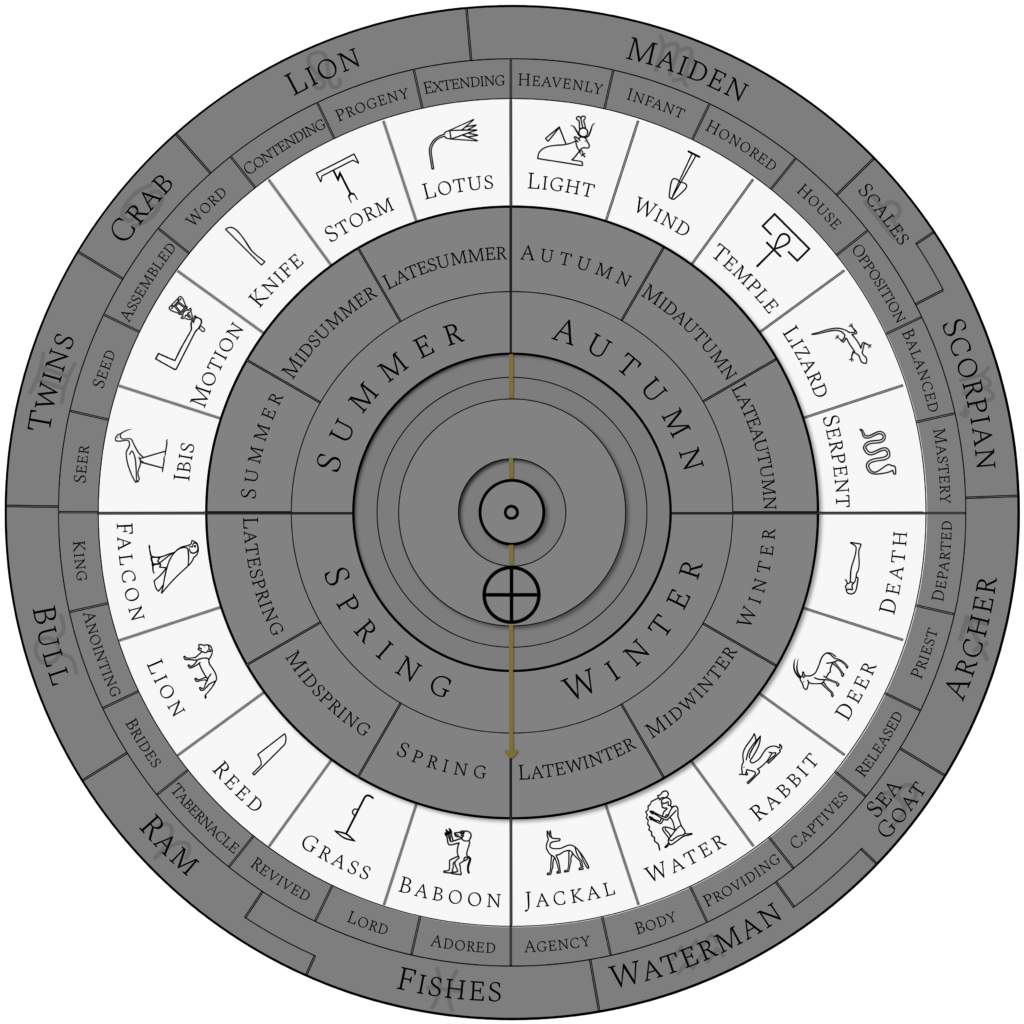

The Aztec symbol for light was a crocodile head or in some depictions a lily pad. Either image was intended to suggest to the mind the idea of floating upon water. The Olmec symbol that preceded this was the sun, hence the name ‘light.’ The Mayan word was “Imix,” which was derived from “Ix” meaning womb, our watery place of physical origin wherein the light of the spirit enters. In a word, it represents conception.
The Egyptian corollary is stunningly similar in meaning. The hieroglyph here represents Hathor, which as a solar deity represents the sun but whose esoteric meaning is Eve and the womb. Though the connection to a watery place is lost here, the strength of the connection to light and the beginning of human life is too compelling to ignore.
Its opposite sign is Baboon; its compliments are Death and Ibis.

All indigenous tribes agree that the meaning of the second symbol is “wind,” although the Aztec glyph is quite bizarre and may have represented a being who produced winds upon the earth. Whereas the first symbol, “Light,” represented the spirit existing before being embodied, the step of “Wind” suggests to the mind physical creation from the moment of embryonic conception all the way to the taking of the first breath at birth. This moment is sometimes referred to in scripture as the “quickening” of the body.
The Egyptian hieroglyph is rather straightforward and has an anatomical explanation that matches the symbolism: it is the lungs and windpipe of a human. As with most ancient traditions, the Egyptians saw the breath as the fundamental component of physical life. In fact, both the Egyptian and Hebrew languages use the same word for breath and the spirit that quickens or animates the person (Egyptian: ka; Hebrew: רוּחַ ruach).
Its opposite sign is Grass; its compliments are Deer and Motion.

A stone temple was depicted by the Aztecs as the next symbol in the sacred round. Although it’s usually just called “house,” the word “Temple” seemed more appropriate to retain here inasmuch as the body, the house of the spirit, is also the temple of the Holy Ghost (see 1 Cor. 6:19). This stage of the sacred round may mark the step in the human journey wherein the spirit of a child fully claims its tabernacle (perhaps after the so-called “fourth trimester,” when most babies begin to display basic eye control).
The Egyptian symbol is actually a composite one: the open rectangle representing a house and the ankh representing health and vitality. Some researchers suggest that the ankh may have been made by twisting the dried umbilical cord into the shape depicted and then placed over the navel of the child as a blessing of health. Visually, this hieroglyph suggests to the mind full and healthy possession of a body by the spirit.
Its opposite sign is Reed; its compliments are Rabbit and Knife.

The Aztec symbol used here represented the beginning of evil in a human being. It was believed that children were born pure and did not sin until a certain age when they became accountable for their own actions. The “Lizard” represents the beginning of this “natural man” within each person that opposes godliness and conceives sin in the heart.
The Egyptian, in this case, is precisely the same—a lizard being a lizard on both hemispheres.
Its opposite sign is Lion; its compliments are Water and Storm.

Ancient symbolism of the serpent was not the exclusive domain of evil. In Egyptian motifs, horizontal serpents could represent danger and evil but a vertical, upright snake could represent wisdom and good. In a similar vein, Moses held up the serpent on the cross as a symbol of Christ to heal the people who would look to it. An additional layer of symbolism comes in the snake’s attribute of shedding its skin. This suggests to the mind learning from and putting off old, broken ways and becoming something new, or in another word, the rebirth of the changed person. In the light of this symbol being the next stage in human development, it represents maturity and adulthood. Furthermore, as a snake coils, even so does a person gather together all their experiences of life at this stage.
The Egyptian is also a serpent with its head raised.
Its opposite sign is Falcon; its compliments are Jackal and Lotus.

The Aztec symbol of a skull represented “Death.” It also marks the beginning of winter. From a mortal perspective, death would seem to be the conclusion of the soul’s journey, but to the Aztecs it was only the beginning of the next three-quarters of human development! Therefore the representation of “Death” on the calendar should not evoke fear from the reader; although death is an end of one thing, it is also a beginning of an ongoing process.
The Egyptian hieroglyph selected is an embalmed corpse, or mummy, laying face-up on its back. This is to reflect the heavy Egyptian emphasis on death as a mere step wherein the departed looks forward and onward to many things to come.
Its opposite sign is Ibis; its compliments are Baboon and Light.

The Aztec symbol “Deer” suggests to the mind being fleet of foot, able to move about quickly and easily. This is a reference to the ability a spirit has once freed from the confines of a dying body. Other symbolism may include the reported fleeting summary of mortality’s experiences seen after passing into the spirit realm. It represents the haste with which a departed spirit may have to act in pursuit of its continued development.
The Egyptian corollary is a gazelle, which in some African languages is named literally “swift deer,” thus preserving the above symbolism. There is some association between the symbol of a gazelle in ancient Egyptian texts and the concept of rebirth, or in this case, a new form of continued existence.
Its opposite sign is Motion; its compliments are Grass and Wind.

The “Rabbit” was the Aztec symbol for the spirit’s need to escape the material world. Apparently it is necessary for a person after death to fully divest themselves from the trappings of physical things. The way in which a rabbit leaps high into the air to escape pursuit is symbolic of this struggle, progressing only in fits and starts. Thus the struggle of the spirit at this stage of life is one of an inner sacrifice of outer things. In a word, it represents the notion of consecration.
The Egyptian symbol is the same, though some emphasis seems to be placed on the ears of the rabbit, suggesting to the mind the need for the spirit to listen or focus on the subtler world of spirit in the pursuit of sacrificing a prior love for material things.
Its opposite sign is Knife; its compliments are Reed and Temple.

On the Aztec calendar, a decorated basin of “Water” was depicted for this stage of life. It represented the reward for successfully sacrificing material attachments in the previous stage of “Rabbit.” Passing through the waters in many ancient traditions could be seen as a purification or cleansing ceremony, such as baptism in Christianity. That this symbol should follow “Death” should not be surprising given Paul’s teaching on baptism for the dead; statistically speaking, if the living are to be baptized for their dead, then the majority of humanity who obtain to this ordinance would do so after death.
The Egyptian image is of a man with a vase of water poured out over his head. This anthropomorphic involvement in the symbol is more in line with the constellation of the waterman (Aquarius), which aligns with this portion of the veintena, as will be explained in the Holy Star Wheel. The meaning is the same as the Aztec: cleanliness, which is its own reward.
Its opposite sign is Storm; its compliments are Lion and Lizard.

The “Jackal” represents one of the two lowest points in the veintena sacred round (the other being the next phase, “Baboon”). The Aztec symbol represented a critical junction in a spirit’s journey: was it going to go forward or backward? The dog, though loyal, could be indecisive and easily distracted if not properly disciplined and trained. The conflict represents, in a word, anguish of soul.
The Egyptian hieroglyph chosen wonderfully embodies these same concepts by depicting the “Jackal” with its head turned backward in the direction from which it had come. Dogs and jackals alike are known for “returning to its vomit” being interested only in fulfilling its base appetites. A spirit at this stage must persevere in choosing further light and truth or else it would return to its former state and be worse off.
Its opposite sign is Lotus; its compliments are Falcon and Serpent.

This is the other symbol at the bottom of the wheel, but, unlike “Jackal,” this stage has crossed beyond the crucial threshold of deliberation and now begins the ascent phase toward regeneration. The Mayan priests said this was a stage wherein a person “burns without flame,” which may suggest to the mind the process of sanctification and purging by the baptism of fire.
Though the Aztecs were more familiar with monkeys in their glyphs, the Egyptian “Baboon” was an even more fitting and poignant symbol to use here. Most often depicted with raised hands, baboons in Egypt were noted for watching the sunrise and extending their hands upward to receive its warming rays as it crested the horizon. In this petitionary position, the anticipation of increased light is exemplified. This is the happy state of mind of those baptized by fire.
Its opposite sign is Light; its compliments are Ibis and Death.

An extremely strange and unusual Aztec glyph was here called “Grass.” The image is that of a human jawbone, with perhaps other decaying flesh still attached (indicating an un-ceremonial death, murder, or the shedding of innocent blood), with grass growing out from underneath. This suggests to the mind the first stage of regeneration of life, and also that matter flows from one spirit to another as lifeforms come and go in this world. It is associated with obtaining a promise of resurrection from the dead, a rescue from hell.
Unfathomably, the Egyptians had a similar hieroglyph: a mouth (the diamond shape at the bottom) with a stalk of grass growing out of it! (Interestingly, there’s even a half-circle appendage in the grass as well.) This unexpected synchronicity is indicative of the truth and ancientness of the imagery, perhaps evoking the memory of the first murder and promise of eternal life to Abel.
Its opposite sign is Wind; its compliments are Motion and Deer.

A “Reed” is a fully-developed, strong, tall, and straight stalk of a certain type of grass (or at least it is frequently referred to taxonomically as a grass). In the ancient view, this is the next form taken by “Grass” and hence is the next step in the stage of life as depicted by the Aztecs. It symbolizes the upright resurrected body. Its hollowness may also fit as a symbol of a resurrected body being devoid of corruption, or blood. That it stands straight indicates the ascension of the resurrected being to a pre-prepared heaven.
The Egyptian hieroglyph is also of a reed though with its flowering panicle depicted, emphasizing the upright and fully matured nature of the standing stalk.
Its opposite sign is Temple; its compliments are Knife and Rabbit.

The Aztecs saw the jaguar as a symbol of the warrior. Mayan priests associated this stage with further refinement and cleansing. Aztec connections between the jaguar and the underworld may suggest to the mind a purifying or transformative aspect of the journey of the soul. That is should follow “Reed” or resurrection may be indicative of some aspect of the mortal journey of transformation taken to attain to glory after resurrection.
The Egyptian equivalent chosen is the “Lion,” a symbol of Christ and of Judah in general. The “Lion” is also the alpha to a pack of lionesses and thus represents the purifying and glorifying effect of celestial marriage. This office is associated with the spiritual station of Prophet.
Its opposite sign is Lizard; its compliments are Storm and Water.

The Aztec symbol of the eagle is one of the most important to their culture. It represented the peak of man’s attainments in their warriors and leaders and was also a symbol of the sun god,
Huitzilopochtli. As an intermediary with the heavens, the eagle also represented divine appointment, as with the founding of
Tenochtitlán.
The Egyptian symbol of the “Falcon” mirrors these motifs perfectly. It was the symbol for the god Horus, a symbol of Christ through the motif of the redeeming son who ascends to the throne of his father. And Horus was associated with the sun and divine appointment, specifically to kingship. Where the “Lion” suggested to the mind husbandry and priestliness, the “Falcon” suggests the next attainments of fatherhood and kingship—in short, godhood. This phase is associated with the spiritual station of Revelator.
Its opposite sign is Serpent; its compliments are Lotus and Jackal.

American tribes variously see this phase as a condor or thunderbird (as the Aztecs) or as an owl. Both birds symbolize higher wisdom and understanding in different ways (for example, the thunderbird was the only bird to fly higher than the eagle, which was the previous phase).
The Egyptian hieroglyph chosen was the “Ibis,” which was a bird sacred to the Egyptians and associated with the god, Thoth, who is connected with Enoch. Thoth, with his “Ibis” head, personified the deific principle of wisdom and foresight. This is fitting with Enoch, who was considered to be something even greater than a prophet: a seer. This is due to his ability to see all realities, spiritual and physical, at the same time. This phase is associated with the spiritual station of Seer.
Its opposite sign is Death; its compliments are Light and Baboon.

This glyph is a little cryptic and may have represented some sort of rattle or implement of worship that had to be shaken. This phase was called “Motion” by the Aztecs and represented the day when the soul shook off the last ashes of materialism that may have clung to the soul. It also pertained to fertility.
The Egyptian hieroglyph chosen bears striking similarity in meaning. It is a sort of instrument like a tambourine used in the worship of Hathor by her priestesses, the device itself bearing the image of Hathor’s face in her bovine form. It too played a role, inasmuch as Hathor represented the reproductive center, in fertility rites of some kind. As a symbol of a post-mortal phase, it suggests to the mind eternal lives through an unfolding kingdom of posterity proceeding forth from one man to become as the sands of the seashore as a reward to those who have overcome the lusts of the flesh. This is the definition of obtaining exaltation in the highest degree of heaven.
Its opposite sign is Deer; its compliments are Wind and Grass.

The Aztec symbol here was a flint knife, symbolizing sacrifice.
The Egyptian corollary chosen is also a knife, albeit with a more recognizable shape. Beyond suggesting to the mind the need for sacrifice, a sharp blade is also a scriptural symbol for the word of God, which has the power to cut to a being’s center and test the very heart strings. (The Book of Enoch also hints at the ability for resurrected beings to lose their bodies via ceremonial death blows using a sharp implement, perhaps also symbolic in nature, which process may be worth noting at this phase of the cycle.)
Its opposite sign is Rabbit; its compliments are Temple and Reed.

The Aztec symbol for “Storm” appears to perhaps be the personification of a wind god. Other Native Americans referred to the 19th phase as rain, lightning, or fire (lightning was long considered to be fire). It was said to the day when the divine nature was manifest, perhaps referring to the שְׁכִינָה (shekhinah, “dwelling”) or intense glow, often compared to fire or lightning, that surrounds God. Like a knife dividing two parts of a whole, this power emanating from his presence is said to both sanctify the righteous and consume the wicked.
The Egyptian hieroglyph is one of a lightning bolt coming down out of a cloud or the sky. Storms are associated with violent conflict and war, as with the Egyptian god Set, the god of chaos, storms, and war. Set is Horus’ adversary and competitor for the throne of Osiris, making Set a fitting parallel for Lucifer who fell from heaven “like lightning” after his failed coup to take the throne from the Father and the Son. Therefore this phase may point to spiritual darkness, seeking for power, and division among mighty powers.
Its opposite sign is Water; its compliments are Lizard and Lion.

The final stage of the veintena was called flower or Lord variously by the Native Americans who used this calendar. The glyph appears to be a flower plucked out with its roots intact. It was said to be the phase where the soul obtained unity or oneness with God, having returned to his bosom, the place from whence it issued.
The hieroglyph chosen is of an Egyptian lotus flower, which held special symbolic meaning with its ability to open in the morning and close at night. Its glyph was intended to evoke the idea of creation and rebirth, akin to the Buddhist use of the same symbol. According to Egyptian creation myth, Atum, the first man, emerged from the primordial waters out of a “Lotus” flower. It is a moment of full contemplation and the mark of a completed cycle, marking the peak of the phases along with its closely related next phase (“Light”).
Its opposite sign is Jackal; its compliments are Serpent and Falcon.
Synchronicity
The above guiding definitions for the veintena symbols will be important to refer to as you continue to learn about the other sacred calendars that are incorporated into one format in the Restored Enoch Calendar. Their meanings will overlap with and deepen your understanding of the other calendars. Astonishingly, as you will see, all of these will work together to testify of Christ.
Note that each veintena symbol has a sign opposite the circle that provides different meaning to ponder upon for any given date. There are also compliments to either side to reflect upon as well. The circle has a top and a bottom, descending side and an ascending side—all further symbolism to suggest to the mind deeper meanings and concepts.
Think also to the seasons and months established by the Restored Enoch Calendar and how they align to the symbols when overlaid against one another: each of the four seasons aligning with different principle phases of the soul’s journey: Mortality, Death/Spirit World, Resurrection, and the Heavens. All of these simple yet brilliant synchronicity’s testify of God as the true author of this time keeping system.
And that is only what we learn from two calendars. Ready for more?